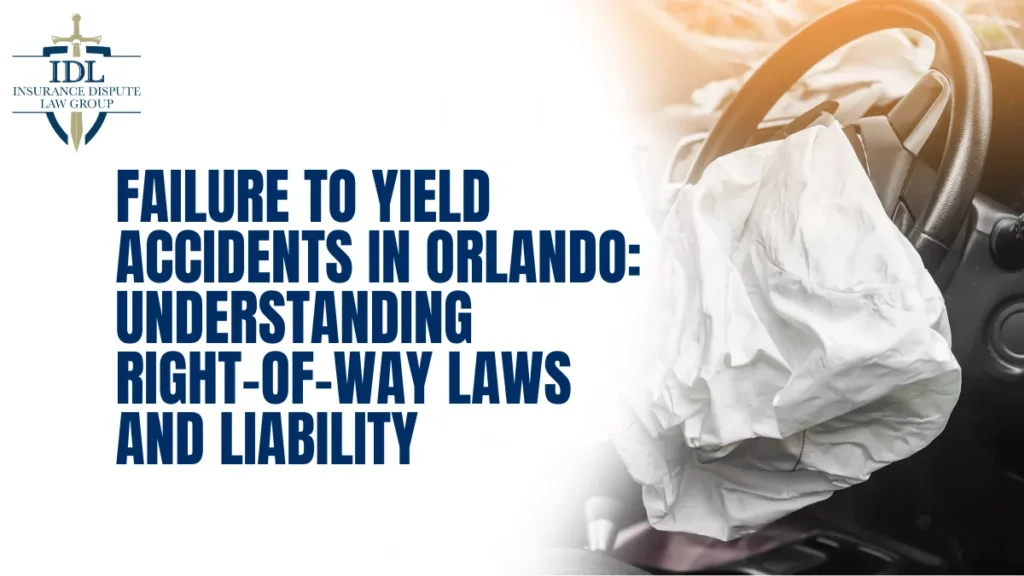
Failure to yield is one of the leading causes of car accidents in Orlando and throughout Central Florida. These accidents often happen in intersections, during left turns, or when drivers merge into traffic without properly checking for other vehicles. When a driver ignores right-of-way laws, the results can be sudden, violent, and life-changing.
Many drivers misunderstand who has the right of way in different traffic situations. Unfortunately, even a brief moment of confusion or impatience can lead to serious injuries and costly damages.
If you were injured in a failure-to-yield accident, you may have the right to pursue compensation. At Insurance Dispute Law Group, we help accident victims in Orlando determine liability, gather evidence, and fight for the compensation they deserve.
Complete our free case evaluation form or call us now at 407-573-5402 to protect your rights.
What Does “Failure to Yield” Mean?
Failure to yield occurs when a driver does not give the right of way to another vehicle, pedestrian, or cyclist when required by law.
Right-of-way laws are designed to keep traffic flowing safely and prevent collisions. When a driver ignores these rules, they create dangerous situations that can lead to accidents.
Common Failure-to-Yield Scenarios
Failure-to-yield accidents can occur in many different traffic situations.
Left-Turn Accidents
One of the most common scenarios involves a driver turning left in front of oncoming traffic without yielding.
Intersection Accidents
Drivers may fail to yield at stop signs or traffic signals, leading to T-bone collisions.
Merging Accidents
Drivers entering highways or changing lanes may fail to yield to vehicles already in the lane.
Pedestrian Crosswalk Accidents
Drivers must yield to pedestrians in crosswalks. Failing to do so can result in serious injuries.
Roundabout Accidents
Drivers entering a roundabout must yield to vehicles already circulating.

Why Failure-to-Yield Accidents Are Common in Orlando
Orlando’s traffic environment increases the likelihood of right-of-way violations.
Contributing factors include:
- Heavy traffic congestion
- Tourist drivers unfamiliar with local roads
- Complex intersections
- Distracted driving
- Aggressive driving behavior
- High-speed roadways
These conditions make it easier for drivers to misjudge or ignore right-of-way rules.
Common Causes of Failure-to-Yield Accidents
Most failure-to-yield accidents are caused by driver negligence.
Distracted Driving
Drivers using phones or navigation systems may fail to notice other vehicles or pedestrians.
Speeding
Excessive speed makes it harder to judge gaps in traffic.
Impatience
Drivers may rush through intersections or attempt risky turns.
Poor Visibility
Obstructed views can lead to dangerous decisions.
Inexperience
Inexperienced drivers may not fully understand right-of-way rules.
Common Types of Failure-to-Yield Accidents
Failure-to-yield violations often result in serious collisions.
Common accident types include:
- T-bone (side-impact) crashes
- Left-turn collisions
- Pedestrian accidents
- Bicycle accidents
- Highway merge crashes
These accidents often occur without warning and at full speed.
Who Is Liable in a Failure-to-Yield Accident?
In most cases, the driver who failed to yield is responsible for the accident.
Drivers are required to:
- Yield to oncoming traffic when turning left
- Yield to vehicles already in the roadway when merging
- Yield to pedestrians in crosswalks
- Obey traffic signals and signs
Failing to follow these rules is considered negligence.
When Liability May Be Shared
In some cases, more than one driver may share responsibility.
Examples include:
- One driver failed to yield
- The other driver was speeding or distracted
Under Florida’s comparative negligence law, fault can be divided among multiple parties.
If you are partially at fault, your compensation may be reduced based on your percentage of responsibility.
Common Injuries in Failure-to-Yield Accidents
Because these accidents often involve side-impact or high-speed collisions, injuries can be severe.
Common injuries include:
- Traumatic brain injuries (TBI)
- Spinal cord injuries
- Broken bones
- Internal organ damage
- Neck and back injuries
- Permanent disability
Victims may require long-term medical care and rehabilitation.
Florida’s No-Fault Insurance System
Florida operates under a no-fault insurance system, meaning your Personal Injury Protection (PIP) coverage will initially cover medical expenses and lost wages.
However, if your injuries are serious, you may be able to pursue a claim against the at-fault driver for additional damages.
Serious injuries may include:
- Permanent injuries
- Significant scarring or disfigurement
- Loss of bodily function
Compensation Available After a Failure-to-Yield Accident
Victims may be entitled to compensation for both financial and personal losses.
Economic Damages
- Medical expenses
- Hospital bills
- Surgery and rehabilitation
- Future medical care
- Lost wages
- Loss of earning capacity
- Property damage
Non-Economic Damages
- Pain and suffering
- Emotional distress
- PTSD
- Loss of enjoyment of life
- Permanent disability
These damages can significantly impact your overall recovery.
How Insurance Companies Handle Failure-to-Yield Claims
Insurance companies often attempt to reduce liability by arguing:
- The other driver had time to avoid the crash
- The victim was partially at fault
- The accident was unavoidable
- Injuries are exaggerated
Without strong evidence, insurers may reduce or deny valid claims.
Evidence Used to Prove Fault
At Insurance Dispute Law Group, we gather key evidence to establish liability.
This may include:
- Police accident reports
- Traffic camera footage
- Witness statements
- Vehicle damage analysis
- Black box data
- Accident reconstruction reports
Early investigation helps preserve this evidence.
What to Do After a Failure-to-Yield Accident in Orlando
If you are involved in this type of crash:
- Call 911 immediately
- Seek medical attention
- Document the scene with photos
- Gather witness information
- Avoid discussing fault
- Contact an experienced accident attorney
Taking these steps can protect your legal rights.
How Insurance Dispute Law Group Helps Accident Victims
Failure-to-yield accident claims often require detailed investigation and strong legal advocacy.
At Insurance Dispute Law Group, we help victims by:
- Investigating the crash thoroughly
- Identifying all liable parties
- Gathering critical evidence
- Negotiating with insurance companies
- Preparing cases for trial when necessary
Our goal is to help accident victims recover the full compensation they deserve.
Injured in a Failure-to-Yield Accident in Orlando? We’re Ready to Help
Failure-to-yield accidents are preventable — and when they occur, victims should not be left to deal with the consequences alone.
At Insurance Dispute Law Group, we fight for accident victims across Orlando and Central Florida.
Take the next step today:
Complete the free case evaluation form
Call us now at 407-573-5402
You focus on recovery — we’ll fight for the compensation you deserve.
Sources
1. Florida Department of Highway Safety and Motor Vehicles (FLHSMV)
Provides information on traffic laws and crash statistics in Florida.
https://www.flhsmv.gov/
2. National Highway Traffic Safety Administration (NHTSA)
Offers research and data on intersection and right-of-way accidents.
https://www.nhtsa.gov/
3. Insurance Information Institute (III)
Provides information on auto insurance claims and liability issues.
https://www.iii.org/