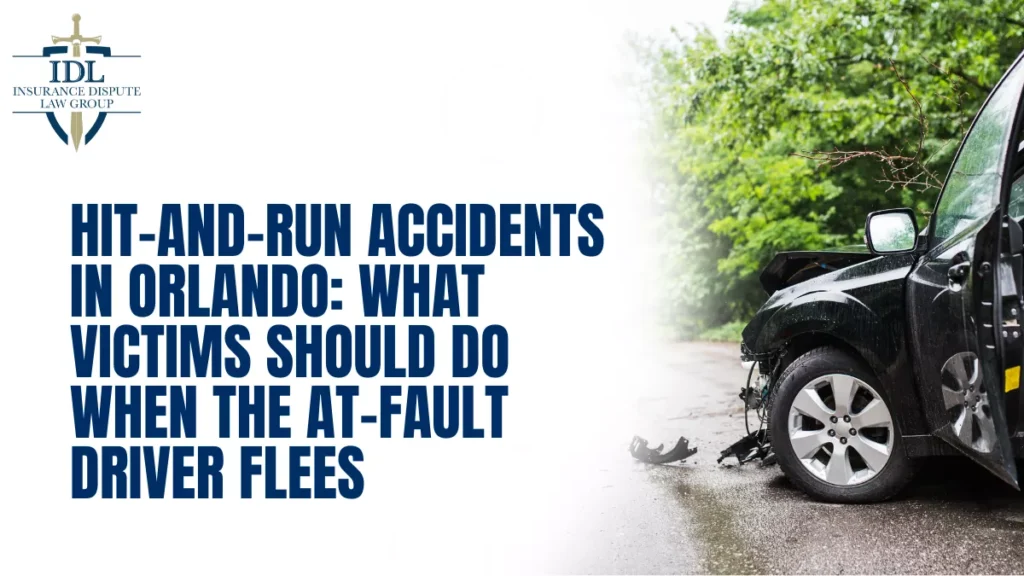
Hit-and-run accidents are among the most frustrating and traumatic types of car crashes. In these incidents, the driver who caused the collision leaves the scene without providing identification, insurance information, or assistance to injured victims. Unfortunately, hit-and-run crashes occur frequently in Orlando and throughout Central Florida.
When a driver flees the scene, victims are often left dealing with serious injuries, property damage, and uncertainty about how they will recover compensation. However, even if the at-fault driver cannot be identified immediately, you may still have legal options.
At Insurance Dispute Law Group, we help hit-and-run accident victims across Orlando pursue compensation through insurance coverage, investigations, and legal action when possible. This article explains why hit-and-run accidents happen, what victims should do immediately after the crash, and how compensation may still be available.
What Is a Hit-and-Run Accident?
A hit-and-run accident occurs when a driver involved in a crash leaves the scene without fulfilling their legal obligations.
Under Florida law, drivers involved in an accident must:
- Stop at the scene
- Provide their name, address, and vehicle information
- Provide insurance details
- Render reasonable aid to injured individuals
- Report the accident if injuries or property damage occur
Leaving the scene of an accident is a serious criminal offense in Florida, especially if injuries are involved.
Why Drivers Flee the Scene After an Accident
Drivers may flee the scene of a crash for several reasons, including:
- Driving without insurance
- Driving with a suspended or revoked license
- Driving under the influence of alcohol or drugs
- Fear of arrest
- Outstanding warrants
- Panic or poor judgment
Regardless of the reason, leaving the scene of an accident is illegal and can result in severe criminal penalties.

Where Hit-and-Run Accidents Commonly Occur in Orlando
Hit-and-run crashes can occur anywhere, but they are especially common in areas with heavy traffic and limited visibility.
Common locations include:
- Busy intersections
- Downtown Orlando streets
- Parking lots and shopping centers
- Highways like I-4
- Tourist areas near attractions
- Residential neighborhoods
Some drivers flee even after minor collisions, while others leave victims seriously injured.
Common Types of Hit-and-Run Accidents
Hit-and-run crashes can involve several types of collisions:
- Rear-end collisions
- Intersection accidents
- Pedestrian accidents
- Bicycle accidents
- Parked vehicle collisions
- Multi-vehicle crashes
Pedestrians and cyclists are especially vulnerable in hit-and-run cases.
Common Injuries in Hit-and-Run Accidents
Because many hit-and-run accidents occur suddenly and without warning, victims often suffer serious injuries.
Common injuries include:
- Traumatic brain injuries (TBI)
- Spinal cord injuries
- Broken bones
- Internal organ damage
- Severe lacerations
- Soft tissue injuries
- Permanent disability
These injuries can lead to long-term medical care and financial hardship.
What to Do Immediately After a Hit-and-Run Accident
If you are involved in a hit-and-run crash, taking the right steps can improve your chances of identifying the driver and recovering compensation.
Call 911 Immediately
Report the accident to law enforcement right away. A police report will be essential for insurance claims and investigations.
Seek Medical Attention
Even if injuries seem minor, it is important to receive medical evaluation as soon as possible.
Document the Scene
If possible, take photos or videos of:
- Vehicle damage
- The accident location
- Road conditions
- Debris from the other vehicle
Gather Witness Information
Witnesses may have seen the vehicle flee or recorded important details such as the license plate number.
Look for Nearby Cameras
Traffic cameras, security cameras, or dashcams may capture footage of the fleeing vehicle.
How Police Investigate Hit-and-Run Accidents
Law enforcement officers investigate hit-and-run crashes by reviewing:
- Witness statements
- Traffic camera footage
- Surveillance video from nearby businesses
- Debris from the suspect vehicle
- License plate information
In some cases, the at-fault driver can be identified and charged.
Can You Still Recover Compensation After a Hit-and-Run?
Yes. Even if the driver is never identified, victims may still have options for recovering compensation.
Uninsured Motorist (UM) Coverage
Uninsured motorist coverage is often the most important protection in hit-and-run accidents.
UM coverage may pay for:
- Medical expenses
- Lost wages
- Pain and suffering
- Future medical care
In many cases, hit-and-run accidents are treated as uninsured driver claims.
Personal Injury Protection (PIP)
Florida’s Personal Injury Protection (PIP) coverage may cover a portion of medical expenses and lost wages regardless of fault.
However, PIP coverage is limited and may not cover all damages in serious injury cases.
Other Insurance Policies
In some situations, additional insurance policies may apply, including:
- Household insurance policies
- Employer policies if the victim was working
- Commercial insurance policies
A thorough investigation may uncover additional sources of compensation.
Florida’s Comparative Negligence Law
Even in hit-and-run cases, insurance companies may attempt to argue that the victim was partially responsible for the crash.
Under Florida’s comparative negligence law, compensation may be reduced by the victim’s percentage of fault.
Insurance companies often use this tactic to minimize payouts.
How Insurance Companies Handle Hit-and-Run Claims
Insurance companies frequently challenge hit-and-run claims by arguing:
- The accident was not actually a hit-and-run
- The injuries are exaggerated
- Medical treatment was unnecessary
- There is insufficient evidence of the crash
These tactics can make recovering compensation difficult without legal representation.
Evidence That Can Strengthen a Hit-and-Run Claim
At Insurance Dispute Law Group, we help gather and preserve important evidence, including:
- Police reports
- Witness statements
- Surveillance video
- Traffic camera footage
- Vehicle debris analysis
- Medical records
- Accident reconstruction reports
The sooner an investigation begins, the better the chances of preserving key evidence.
How Insurance Dispute Law Group Helps Hit-and-Run Victims
Hit-and-run accident cases often require extensive investigation and aggressive legal advocacy.
At Insurance Dispute Law Group, we help victims by:
- Investigating the accident
- Identifying potential insurance coverage
- Gathering critical evidence
- Negotiating with insurance companies
- Pursuing litigation when necessary
Our goal is to ensure victims are not left paying for someone else’s negligence.

Injured in a Hit-and-Run Accident in Orlando? We’re Ready to Help
Being involved in a hit-and-run accident can feel overwhelming, especially when the responsible driver disappears. However, you still have legal options.
At Insurance Dispute Law Group, we fight for hit-and-run accident victims across Orlando and Central Florida.
Take the next step today:
Complete the free case evaluation form
Call us now at 407-573-5402
You focus on recovery — we’ll fight for the compensation you deserve.
Sources
1. Florida Department of Highway Safety and Motor Vehicles (FLHSMV)
Provides information about Florida traffic laws and hit-and-run accident statistics.
https://www.flhsmv.gov/
2. National Highway Traffic Safety Administration (NHTSA)
Offers national data and safety research related to hit-and-run accidents.
https://www.nhtsa.gov/
3. Insurance Information Institute (III)
Provides information on uninsured motorist coverage and hit-and-run accident claims.
https://www.iii.org/